

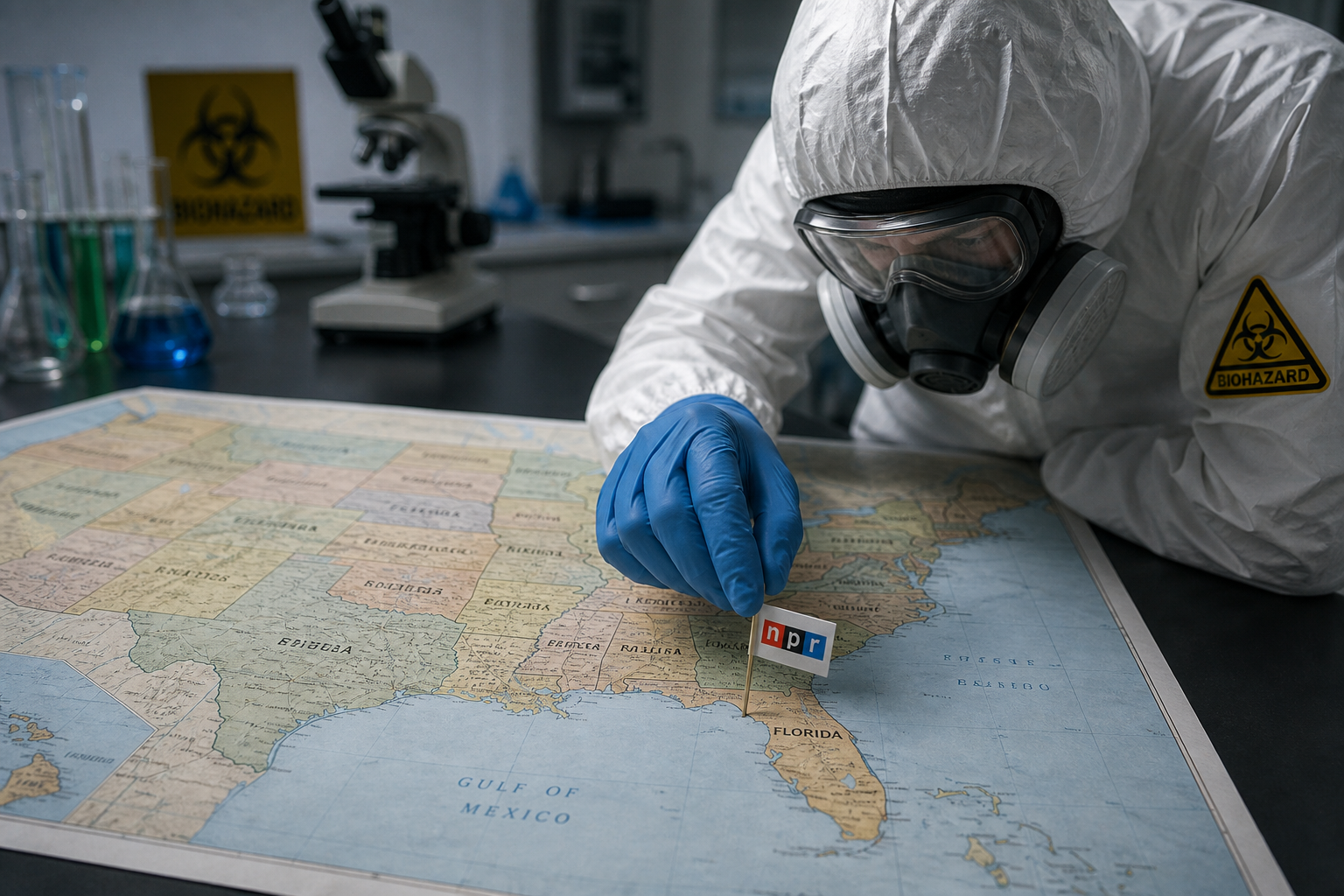
Reporters Brave The Wilds Of Broward County To Report On Newly Discovered Ailment
WASHINGTON, D.C.—In a journalistic breakthrough that has sent ripples through the world of public health reporting, National Public Radio has bravely uncovered the existence of a little-known disease called “the measles.” The virus, which sources confirm has been afflicting humanity for centuries, reportedly only became a matter of national importance last week when it was spotted in its natural habitat: a red state.
“We were stunned,” explained Auden Finch-Whitman, host of NPR’s new pop-up series, Contagion in the Cul-de-Sac. “For years, we’d heard whispers of this ‘measles’ in distant, un-zoned lands—places like Africa, Asia, Europe. But the story always lacked a compelling narrative angle. There was simply no way to tie a massive outbreak in, say, the Democratic Republic of Congo to a failure of suburban voters to trust their betters.”
Everything changed when a handful of cases were reported in a Florida elementary school. Suddenly, the disease was not just a tragic but un-podcastable global health crisis; it was a symptom of a much more fascinating sickness for which NPR already had a diagnosis.
“Once the virus was detected within a 50-mile radius of a ‘Don’t Tread on Me’ flag, we knew we had a story,” Finch-Whitman stated, adjusting his noise-canceling headphones. “It’s a game-changer. We can finally cover this disease through a lens our listeners understand: the unchecked arrogance of people who own pickup trucks.”
According to media analysts, for a disease to achieve NPR-level significance, it must meet a rigorous set of criteria that has little to do with mortality rates or infection numbers:
- Geographic Desirability: Does the outbreak occur in a state that voted for the wrong person in the last election?
- Narrative Convenience: Can the spread be directly linked to “misinformation” and a general distrust of institutions that host pledge drives?
- Character Potential: Are the primary victims people who can be portrayed as tragically misinformed by their governor, rather than as victims of systemic poverty in a developing nation?
The recent Florida outbreak, experts note, checked all the boxes. While the World Health Organization has reported hundreds of thousands of measles cases and thousands of deaths globally in the past year, these figures were widely considered “editorially inert” due to the unfortunate lack of political polarization in the affected regions.
“A cluster of cases in Florida is, from a storytelling perspective, infinitely more compelling than tens of thousands of cases in Yemen,” explained Dr. Cadence Wexler, a professor of Narrative Epidemiology at Oberlin College. “One story is about a complex geopolitical and humanitarian crisis. The other is about a school board that probably also tried to ban a book. You tell me which one makes for a better tote bag slogan.”
Internal memos reportedly reveal NPR is already workshopping future coverage. Segments are planned on how the Florida measles outbreak could threaten democracy, why it is a teachable moment about the importance of federal arts funding, and a special crossover episode with This American Life about one family’s harrowing journey from vaccine hesitancy to voting for Ron DeSantis.
When asked if the network planned to devote similar resources to the much larger outbreaks devastating other parts of the world, an NPR spokesperson demurred. “We are committed to following the story wherever it leads, as long as it leads to a place with interesting electoral maps,” the statement read. “We wish the rest of the world the best of luck with their regional health issues and hope they’ll consider developing some more politically convenient symptoms soon.”


