

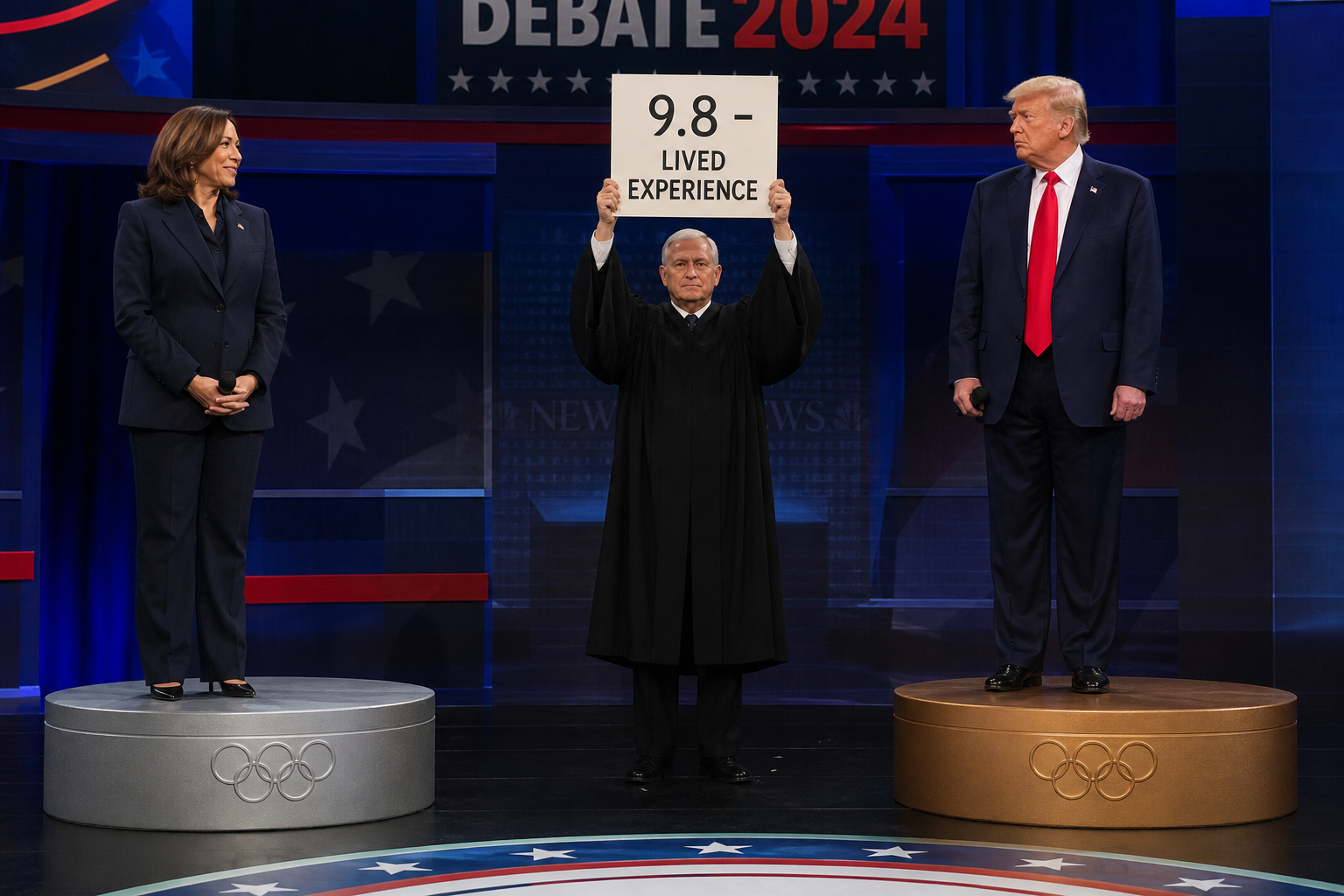
Democrats Unveil New, More Equitable Election Model
BALTIMORE, MD – Following a spirited debate that focused less on tedious subjects like the economy and foreign policy and more on the vibrant tapestry of personal identity, sources within the Democratic National Committee are hailing the Maryland Senate primary as a groundbreaking success for their new electoral model: the Oppression Olympics.
The new format, quietly tested during Friday’s televised debate between Rep. David Trone and Prince George’s County Executive Angela Alsobrooks, replaces antiquated notions of judging candidates on their legislative proposals with a more progressive, points-based rubric of intersectional bona fides.
"For too long, elections have been dominated by boring white papers and discussions of 'facts,' which are themselves a colonial construct," explained a DNC consultant, who identified as a non-binary, quinoa-fluid strategic communications visionary. "We needed a system that quantifies what truly matters: a candidate's lived experience score. Maryland was the perfect place to roll it out."
The Scoring System Explained
According to leaked documents, the scoring was complex. Candidates began with a baseline score determined by their demographic profile. In the debate, Ms. Alsobrooks reportedly scored high marks out of the gate as a Black woman, which commentators noted gave her a significant advantage in the all-important “systemic barriers” category.
Conversely, Mr. Trone, a wealthy white male, started with a substantial point deficit. However, the new rules allow for candidates to earn back points through displays of what the DNC terms “Allyship Acrobatics.”
Points were awarded for the following:
- (5 pts) Mentioning your "lived experience."
- (10 pts) Invoking an oppressed ancestor from at least three generations back.
- (15 pts) Using the phrase "folks from marginalized communities."
- (25 pts) Successfully deflecting a policy question by accusing the moderator of harboring implicit bias.
- (-50 pts) Mentioning the national debt or border security.
How The Candidates Fared
Throughout the debate, Ms. Alsobrooks masterfully centered her identity. When asked about her qualifications, she spoke of being a mother and a Black woman, earning a flurry of points from the judges for her “Authenticity and Representation” score. The move was widely seen as a brilliant tactical play, rendering any discussion of her actual policy record largely irrelevant.
Mr. Trone, facing an uphill battle, attempted a series of high-difficulty maneuvers to close the gap. He repeatedly emphasized his work on criminal justice reform and his commitment to diversity, a classic “Check Your Privilege” gambit that earned him modest points. His strategy seemed to be spending millions of his own dollars to convince voters that, despite all outward appearances, he was actually one of the good ones.
"It was a masterclass in performative self-flagellation," gushed one political analyst. "He couldn't change his demographic score, so he poured his resources into the 'Penitent Ally' category. Bold."
Voters Embrace The New Clarity
Local voters, initially confused by the lack of discussion about inflation or crime, reportedly came around to the new format once they realized it freed them from the burden of critical thinking.
"I used to have to read about their tax plans and stuff. It was exhausting," said area resident Brenda Mills, 42. "Now, I just check the intersectionality scorecard on the DNC app. I know that the person with the most oppression points will govern the most equitably. It's just science."
The DNC is reportedly thrilled with the results and is considering a national rollout for the 2028 presidential primaries. The plan would involve a multi-event competition, including a privilege-checking triathlon, a 400-meter microaggression hurdles race, and a synchronized apology routine.
"This is the future of democracy," the DNC consultant stated, adjusting their sustainably sourced horn-rimmed glasses. "An election shouldn't be a contest of ideas. It should be a pageant of identities, judged by us, for everyone's own good."


