

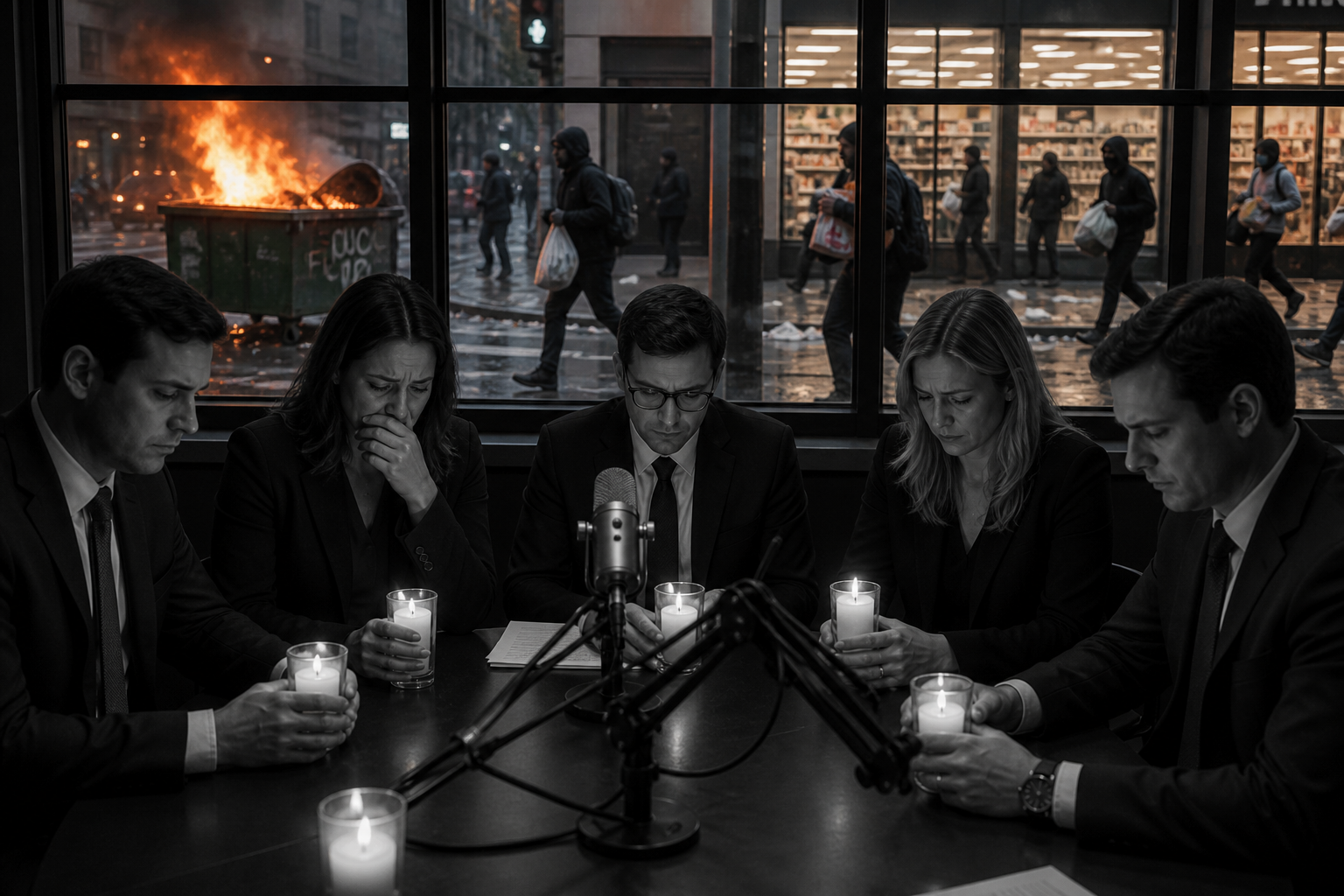
Reporters Solemnly Light Candles For Dying Republic, Step Over Robbery Victim To Get To Work
WASHINGTON, D.C.—In newsrooms across the country, a somber mood has taken hold. Reporters at National Public Radio and The New York Times were seen holding hushed conversations in dimly lit hallways, their faces etched with the grave concern of an ER doctor delivering bad news. The patient, they whispered, is American Democracy. And the prognosis is not good.
“We’re in the final stages,” explained NPR’s lead ‘Democracy Integrity Correspondent,’ a new position created last cycle to monitor the nation’s vital signs. “We’re seeing a rapid erosion of norms, a chilling effect on rhetoric, and a dangerous rise in people voting for candidates we don’t like. We’ve moved the patient to hospice care.”
According to sources, the network’s morning meeting began with a full minute of silent reflection for the ailing republic, followed by a 45-minute segment on how a flag flown at a Supreme Court Justice’s vacation home in 2021 is a five-alarm constitutional fire that makes the British burning the White House look like a minor zoning dispute.
Meanwhile, just outside the NYT’s headquarters, a man in a Spider-Man costume was seen successfully prying the catalytic converter off a Prius with a crowbar in broad daylight, a scene reporters carefully ignored as they hurried inside to write 10,000-word elegies on the death of civil order.
A Very Selective Diagnosis
Experts in the field of Narrative Medicine explain that democracy is an incredibly delicate organism, susceptible to a very specific set of ailments. “Think of it like a child with a severe peanut allergy,” said one prominent media analyst. “It can go into anaphylactic shock if exposed to a conservative talk radio host, a voter ID law, or a red hat. However, it appears to have a robust, almost superhuman immunity to open borders, Soros-funded district attorneys, rampant inflation, and entire city blocks being converted into open-air drug markets. It’s a medical mystery.”
This selective vulnerability has guided coverage for the nation’s most esteemed journalistic institutions. An internal memo from a major newspaper outlined the editorial standard:
- Threat to Democracy: A suburban mom questioning school board policies.
- Not a Threat to Democracy: A mob of protestors attempting to storm a federal courthouse in Portland.
- Threat to Democracy: Someone questioning the results of the 2020 election.
- Vibrant Expression of Civic Duty: Someone questioning the results of the 2016 election.
- Existential Crisis: A state legislature passing a bill to clean up its voter rolls.
- Bold Progressive Governance: A major city reclassifying armed robbery as “impromptu wealth redistribution.”
“You have to understand, our job is to focus on the real dangers,” an anonymous editor for The Times stated, pausing to instruct his assistant to find a new route home that avoided the newly formed autonomous zone in midtown. “While some may be distracted by skyrocketing crime or a fentanyl crisis that is decimating a generation, we have our eyes on the prize: the foundational principles. And those principles are primarily threatened by anyone who thinks the government should maybe spend less money.”
‘We Have To Report What We See, As Long As We See It From This Angle’
Back at NPR, the mood remained funereal. One producer was reportedly so overcome with grief for the nation that he had to be comforted after seeing a poll that showed flagging support for the president among key demographics. “It’s like the country is giving up on itself,” he was heard weeping into a sustainably sourced throw pillow.
The network is reportedly planning a new series titled, “America: Saying Our Goodbyes,” a 12-part audio journey through the nation’s decline, narrated by a host with a voice so calming it could make a carjacking sound like a guided meditation.
As the day’s broadcast wrapped up, the on-air talent signed off with a final, poignant plea for listeners to “stay safe, and cherish the time we have left.” The plea was somewhat muffled by the sound of the station’s front security gate being noisily reinforced for the third time this year.


