

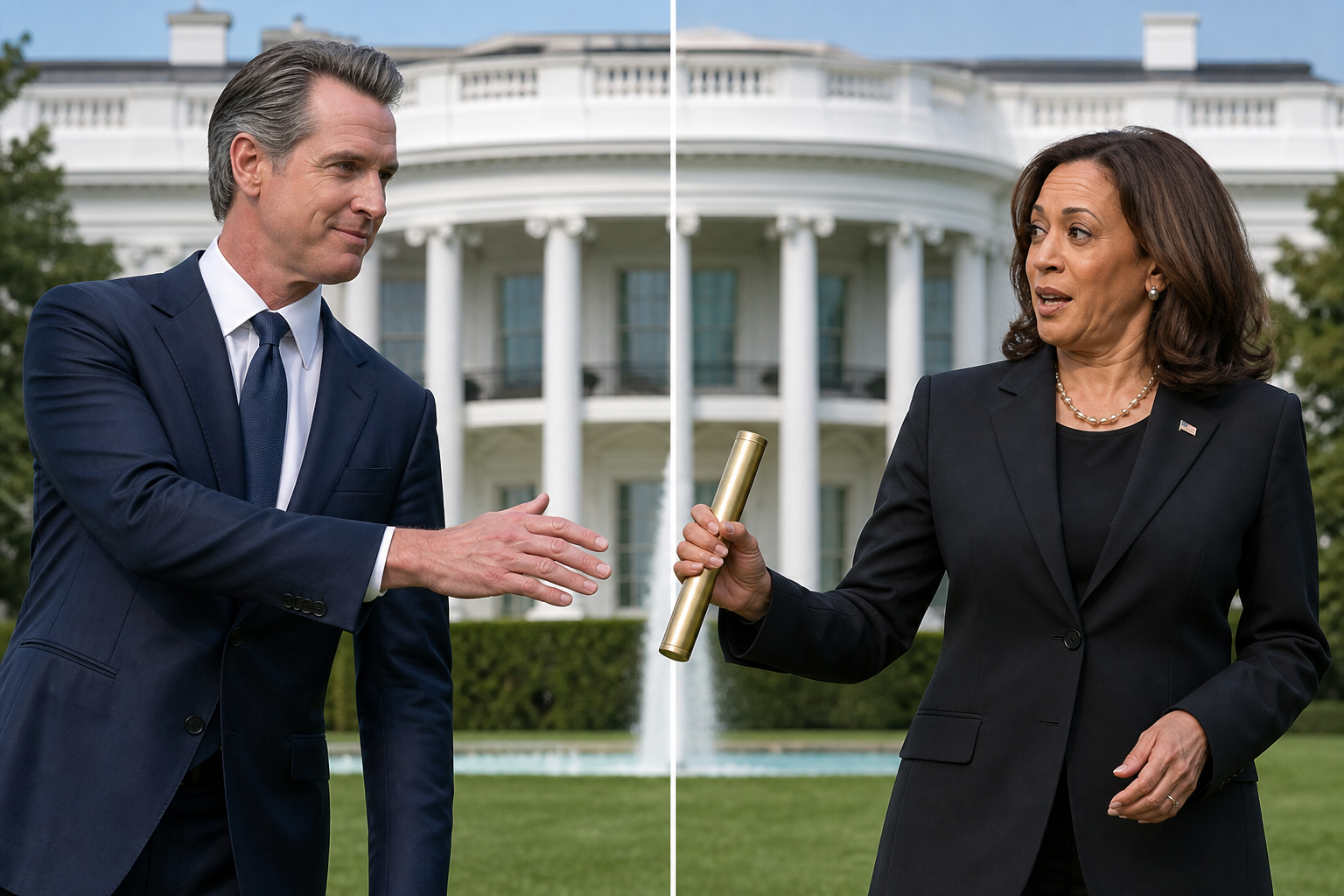
A Profile in Preemptive Concession
WASHINGTON, D.C. – In a decision that has sent ripples of mild acknowledgment across the political landscape, California Governor Gavin Newsom announced Monday that he would not seek the presidency in 2028 if Vice President Kamala Harris decides to run. The heroic declaration effectively averts a potentially grueling primary battle that experts predicted would have been ideologically indistinguishable but differed slightly on hair gel preferences.
Sources say the announcement was made to promote party unity, a goal best achieved by ensuring the eventual nominee is selected from a field of one. By gallantly stepping aside four years in advance, Newsom has spared Democratic voters the agonizing choice between two Bay Area progressives who both believe the solution to every problem is more government spending and a sternly worded tweet.
"This is about the party, not about me," Newsom allegedly told an aide while approving the final lighting for his press conference. "It’s about ensuring a smooth, uncontested transition to a candidate who has already demonstrated a consistent ability to poll somewhere in the mid-to-low 40s. That’s the kind of stability America is craving."
The End of a Rivalry That Never Began
Political analysts were quick to praise Newsom’s strategic foresight, characterizing it as a masterclass in bowing out of a race he was unlikely to win. "It's a bold move to cede the field to the incumbent Vice President, a person who traditionally has the full backing of the party establishment," noted Dr. Alistair Finch, a senior fellow at the Institute for Obvious Political Takes. "By announcing this now, Newsom gets credit for being a team player while avoiding the indignity of actually losing to her."
The decision reportedly came after Newsom’s advisors presented him with a detailed, 200-page slide deck that concluded Harris had a decisive advantage in the key demographic of ‘people who will automatically vote for the sitting Vice President.’
"He’s playing the long game," Finch added. "The long game where you wait to see if the person ahead of you stumbles. It's less of a chess move and more like standing near the finish line of a marathon hoping the frontrunner gets a cramp."
Voters Express Overwhelming Sense of ‘Okay, Sure’
Across the nation, Democratic voters reacted to the news with a collective shrug. "Oh, that’s nice of him, I guess," said Brenda, a part-time pottery instructor and full-time activist from Portland, Oregon. "I was really stressed about having to choose between the person responsible for California's economic miracle and the person who was also there. Now I can focus my energy on more important things, like demanding my local coffee shop remove its problematic new mural."
Another voter, Chad from Los Angeles, expressed relief that his 2028 decision-making process had been simplified. "Look, I get my political opinions from celebrities and late-night talk show hosts," he explained, adjusting his sustainably sourced beanie. "If they all agree on one person, it saves me a lot of time. I'm glad Gavin and Kamala worked this out so I don't have to watch two people I like pretend to disagree on MSNBC for six months."
A Deep Bench of Two
Party insiders are celebrating the move as proof of the Democrats' deep and formidable bench of future leaders. The bench, which now appears to consist of one person sitting on it while another stands politely nearby, is being hailed as a model of efficiency.
"This shows the strength and discipline of our party," said one DNC strategist who asked to remain anonymous. "We have a clear line of succession. There's no chaos, no infighting. Just an orderly, predetermined process that will give the American people the illusion of choice they so desperately crave. It's beautiful, really."
With his presidential ambitions on hold, Newsom can now fully focus on governing California, a state where he has bravely tackled challenges like high taxes, rampant homelessness, and rolling blackouts by occasionally mentioning them in a speech. His supporters are confident that another four years of visionary leadership will only strengthen his position for a potential run in 2032, by which time the state's last remaining taxpayer is expected to have finally moved to Texas.


