

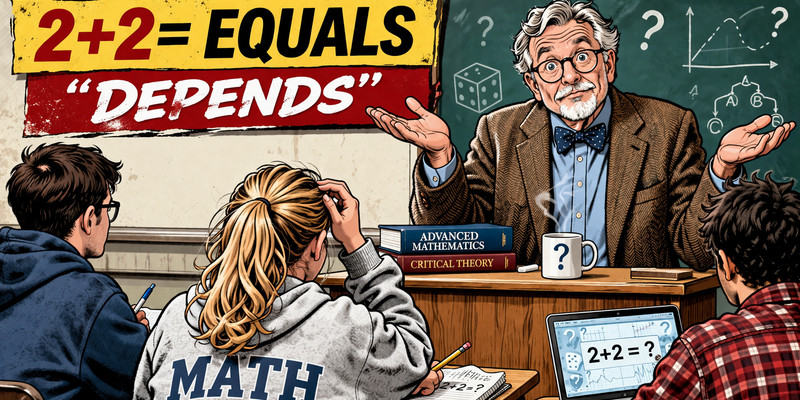
In a sweeping move hailed as “a victory for equity over arithmetic,” several elite universities announced this week they will adopt a new mathematics standard in which the answer to 2+2 is no longer fixed, but instead “contextually fluid.”
The initiative, known as Inclusive Quantitative Reasoning, aims to dismantle what administrators describe as “oppressive numerical rigidity” embedded in traditional math systems.
“For centuries, mathematics has privileged certainty over diversity,” said one university dean. “By insisting that 2+2 equals 4, we’ve excluded countless students who experience numbers differently.”
Under the new guidelines, students will be encouraged to explore a range of possible answers to basic equations, provided they can articulate their reasoning in a reflective essay.
One sample response earning top marks read: “While 2+2 is often said to equal 4, I feel that, in my lived experience, it aligns more closely with 5, due to systemic rounding and emotional expansion.”
Faculty members have embraced the change, noting that it allows for more inclusive grading practices.
“It’s no longer about being right or wrong,” explained a professor of applied philosophy-math fusion. “It’s about being heard.”
Students, too, are adjusting quickly.
“I used to get stressed about exams,” said sophomore Emily Carter. “Now I just write what feels true to me. Last week I got an A for saying 7. The professor said it showed ‘bold numerical storytelling.’”
The shift has sparked concern among employers, particularly in fields like engineering and finance.
“We’re not entirely sure how this will work in practice,” said one hiring manager. “If a bridge collapses, can we just say gravity was being culturally insensitive?”
In response, university officials emphasized that real-world applications of math will also evolve to reflect the new paradigm.
“We’re working toward a future where reality itself is more inclusive,” one administrator clarified. “If necessary, we’ll redefine physics next.”
Some educators have pointed to historical precedent for the change, noting that math has always evolved.
“Zero was once controversial,” said a curriculum designer. “Now it’s widely accepted. Why not ‘2+2 equals vibes’?”
Parents, however, have expressed mixed reactions.
“I’m all for inclusion,” said one father, “but I’d prefer my kid knows how to calculate a tip without writing a personal essay about it.”
Despite the criticism, universities remain committed to the initiative, arguing that it better prepares students for modern challenges.
“In today’s world, confidence often matters more than correctness,” said the dean. “And frankly, 4 has had a monopoly on this equation for far too long.”
At press time, several institutions confirmed they are exploring similar updates in other disciplines, including a history program where timelines are optional and a biology course where students can identify as photosynthetic.
Graduates of the program are expected to enter the workforce this spring, fully equipped to solve problems—just not necessarily the ones you asked.


