

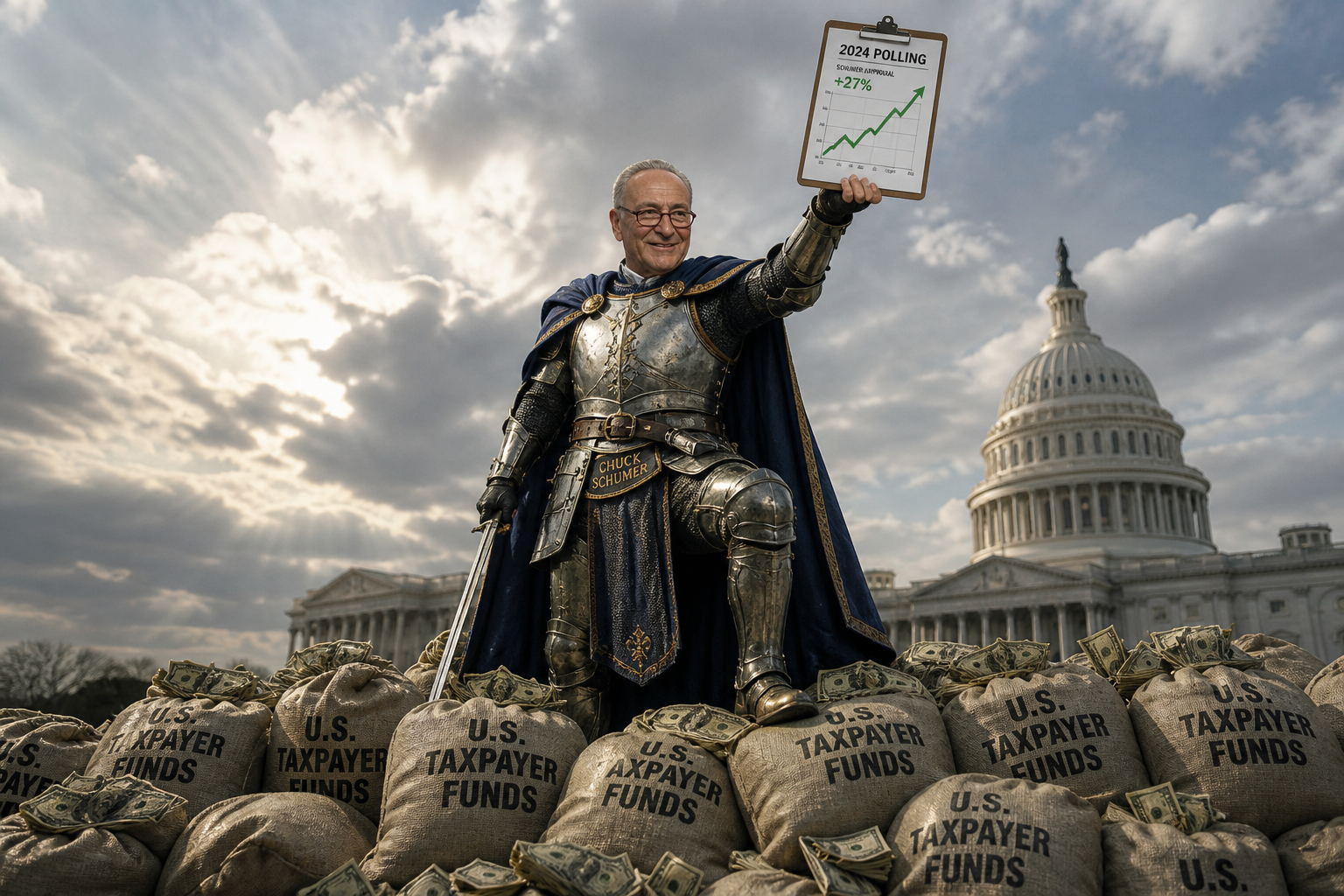
Washington Heroically Spared From Fiscal Responsibility
WASHINGTON, D.C.—In a move being hailed by political consultants and no one else, Senate Majority Leader Chuck Schumer led his caucus in a brave legislative stand this week, successfully blocking a fringe, extremist bill that would have prevented elected officials from using taxpayer money for their own political polling.
The proposed legislation, a radical assault on tradition known as the “No Taxpayer Funding for Polling Act,” sent shockwaves through the capital by suggesting the outlandish idea that politicians should use their own massive campaign war chests to figure out how to get reelected.
“Today, we stood up to a dangerous ideology: the idea that public service shouldn’t come with publicly-funded perks,” Schumer announced in a press conference held in a room presumably paid for by taxpayers. “How can we know what the American people want if we can't use their money to ask them, then use those answers to craft messages to get more of their money? It’s the circle of democracy.”
A Victory for the People (Who Work in Polling)
The bill’s defeat was a monumental victory for the principle of Other People’s Money. For years, politicians have enjoyed the time-honored practice of dipping into federal funds to commission polls that help them fine-tune their messaging, test attack ads, and determine if voters prefer the term “investing in our future” over “astronomical spending.”
“This was a direct attack on our ability to govern effectively,” explained one anonymous Democratic aide while scrolling through Zillow on a government-issued phone. “If we have to use campaign funds for polling, that’s less money for 30-second ads telling everyone how we’re fighting against dark money in politics. The irony would be far too expensive.”
Progressive groups immediately lauded the move. The Coalition for Publicly-Funded Self-Promotion (CFPS) released a statement praising Schumer. “Senator Schumer understands that you can't get big money out of politics if you stop taking public money for politics,” the statement read. “By ensuring the American taxpayer remains the primary angel investor in every politician's career, we maintain a system that is, in its own special way, transparently self-serving.”
The Real Enemy: Accountability
Critics of the defeated bill were quick to point out its many flaws. Dr. Alistair Finch, a senior fellow at the Center for Governmental Introspection, argued that forcing politicians to pay their own way would create an unfair advantage.
“Imagine a world where a senator has to make a choice between commissioning a poll on his new infrastructure slogan and buying another round of TV ads,” Dr. Finch explained. “It would create chaos. Using public funds removes that difficult choice, freeing up our leaders to focus on more important things, like appearing on cable news to discuss the importance of fiscal discipline.”
The victory is part of a broader, noble crusade by Democrats to protect the nation from the corrupting influence of private money in politics, as long as that money isn't flowing to their preferred causes or consultants. It’s a complex ethical stance that boils down to a simple, elegant principle: money is bad, unless it’s our money, or your money that we’re using.
“The American people can rest easy tonight,” Schumer concluded, patting his chest. “We have protected their sacred right to unwittingly contribute to the focus-grouping of our next campaign slogan. We will never stop fighting for their right to fund us.”


