

WASHINGTON, D.C.
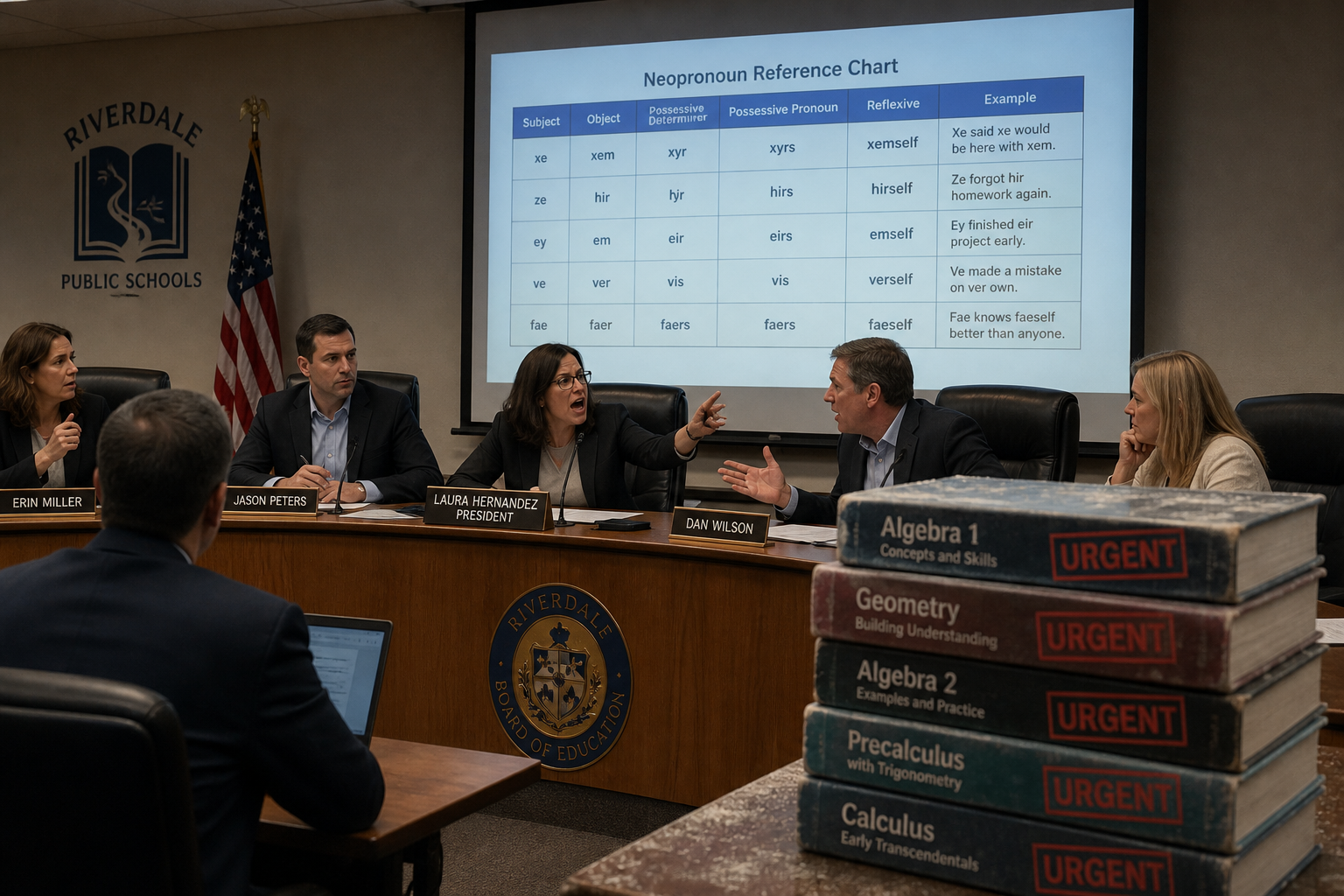
In a bold move hailed by experts with at least three graduate degrees in Feelings Studies, public school systems across the country are tackling record-low parental satisfaction by heroically shifting their focus from outdated concepts like literacy and numeracy to the far more pressing issue of pronoun usage in faculty emails.
A recent Gallup poll revealed that confidence in public schools has cratered, with parents citing concerns over learning loss, curriculum, and basic academic proficiency. In response, school boards from coast to coast have assured the public they are taking these concerns seriously by forming new subcommittees to debate the font size on 'Safe Space' stickers.
'Look, we hear the parents,' said Dr. Aiden Crisp, a DEI consultant for the Elmwood Unified School District, which recently saw its math proficiency scores drop to 'aspirational.' 'They're saying, ‘My child can’t read.’ And what we’re hearing is, ‘My child’s identity isn’t being sufficiently affirmed to create the pre-conditions for potential future literacy.’ It’s really the same thing if you think about it with enough interpretive dance.'
At a recent Elmwood school board meeting, a proposal to fund a new after-school tutoring program for struggling readers was tabled after a tense, four-hour debate erupted over whether the term 'tutoring' was sufficiently inclusive. The board ultimately voted 5-2 to allocate the funds instead to a district-wide 'Linguistic Justice Audit.'
'Some parents are fixated on test scores, which is a very problematic, colonial mindset,' explained board member Jaden Skye. 'True education isn't about right or wrong answers. It's about creating a welcoming environment where a child feels empowered to believe that 7 times 8 could be 56, or it could be a kumquat, depending on their lived experience. We can’t get to that beautiful place until we’ve finalized the 27-page guide on appropriate staff email signatures.'
Local parent Brenda Mills, who attended the meeting hoping to discuss her son's failing grades, was initially confused.
'I just wanted to know why my fourth-grader thinks George Washington invented TikTok,' Mills said, holding a crumpled report card. 'But then I listened to Ms. Skye speak for an hour about the intersectionality of the plus sign, and I realized my priorities were all wrong. My son’s academic failure is a small price to pay for the board's brave stand on grammatical nuance.'
Educational theorists have praised the new approach, calling it 'Post-Academic Pedagogy.' The core tenet is that if students feel sufficiently validated, academic knowledge will spontaneously generate via osmosis.
'For decades, we foolishly believed that teaching children how to read was the way to improve reading scores,' said Dr. Crisp. 'That’s such linear thinking. We now understand that the primary obstacle to reading is not a lack of phonics instruction, but a surplus of heteronormative narratives in classroom libraries and an insufficient number of pronouns available on enrollment forms.'
To that end, school districts are rolling out ambitious new programs. In California, one district is replacing its math curriculum with a year-long seminar on 'Unlearning Numbers.' In Virginia, a high school has replaced its history department with a 'Center for Future-Facing Apologies.'
'We're confident this is the right path forward,' superintendent Skye concluded, gesturing to a chart showing student satisfaction with cafeteria options was also down. 'Once we solve the pronoun issue, we believe the test scores will take care of themselves. And if they don’t, we’ll just declare testing to be a form of institutional violence and abolish it. Problem solved.'


