

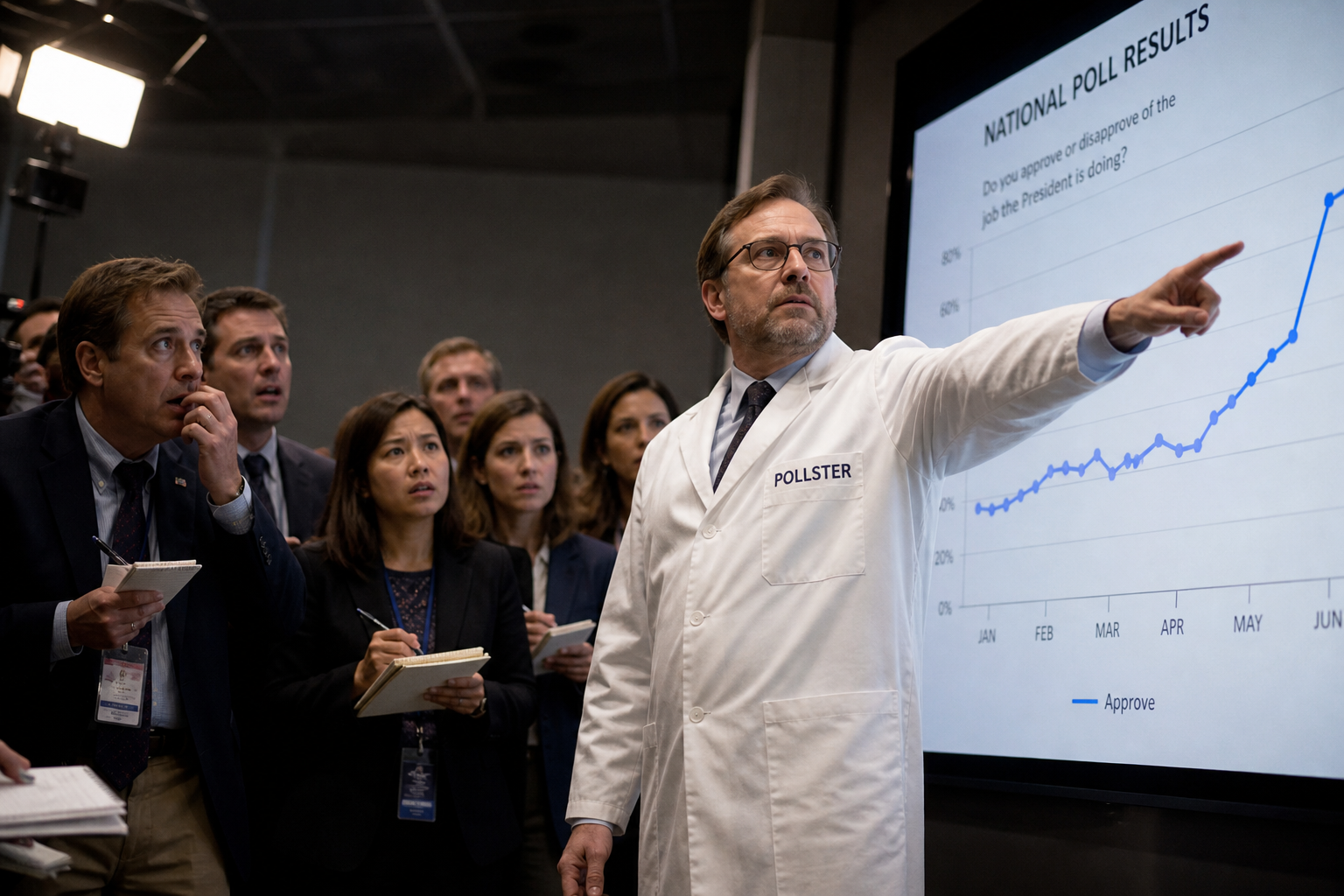
A Beloved National Tradition Commences
WASHINGTON, D.C. — Marking the official start of the high election season, the nation’s most prestigious polling institutions and their media partners this week released the first batch of their much-anticipated “Democrats Are Winning” series of predictive narratives. This heartwarming quadrennial ritual, celebrated by journalists and liberal arts graduates nationwide, provides crucial emotional support during the stressful months leading up to an election.
The latest New York Times/Siena College poll, a cornerstone of the genre, kicked off the season with a dramatic storyline showing a tight race, a significant improvement for Democrats from previous, less optimistic tales. Cable news hosts immediately hailed the numbers as a turning point, dedicating hours of coverage to the poll's intricate methodology, which involved calling 978 carefully selected adults who promised they were registered voters and still answer calls from unknown numbers.
“This is the moment we’ve been waiting for,” declared one primetime anchor, his voice thick with emotion. “These numbers confirm what we’ve all felt in our hearts and discussed at length in our editorial meetings. It’s a testament to the power of hope, and also, a margin of error of +/- 3.5 percent.”
The Science of Narrative Comfort
Experts in the field say these polls serve a vital sociological function, acting less as a predictive tool and more as a form of collective, data-driven therapy. Dr. Alistair Finch, a Senior Fellow in Narrative Validation at the Center for Progressive Numerology, explained the process.
“You have to understand, these polls aren’t meant to predict what will happen in November. That’s a very outdated, literalist interpretation of the data,” Dr. Finch said, adjusting his sustainably sourced horn-rimmed glasses. “Their purpose is to create a safe, affirming space where the correct worldview is shown to be statistically ascendant. Think of it as electoral aromatherapy. The numbers are just the essential oils.”
According to Finch, pollsters have perfected their craft over the years, learning to craft samples that accurately reflect the opinions of people who are most likely to answer a 20-minute phone survey from an unknown number during dinner. Methodologies now include advanced techniques such as oversampling demographics that use the word “problematic” and weighting respondents based on their proximity to a Trader Joe’s.
A Rich History of Getting It Wrong, For The Right Reasons
Critics often point to past polling inaccuracies, most notably the Great Narrative Surprise of 2016, as evidence of failure. But insiders view this as a misunderstanding of the art form. The 2016 cycle, which featured hundreds of polls showing a near-certain victory for the Democratic candidate, is now studied as a masterpiece of sustained suspense-building.
“To call 2016 a ‘miss’ is to miss the point entirely,” explained a veteran pollster who asked to remain anonymous so he could continue working. “We told a beautiful, compelling story of inevitable triumph. The fact that the electorate chose to go with a shocking twist ending is on them, not us. We’re pollsters, not script supervisors for reality.”
This year’s narrative offerings are expected to be the most sophisticated yet. Media outlets have already begun crafting their story arcs, with headlines celebrating every 1-point shift as a “seismic” event and every unfavorable data point as an “outlier” that proves the overall strength of the main trend.
Looking Ahead: Managing Expectations
As the season progresses, Americans can expect a steady stream of these comforting statistical reports. They will be dissected on television panels, shared on social media with captions like “THIS‼️”, and cited in arguments with relatives over holiday dinners.
Of course, there is always the risk that the non-canon events of Election Day may diverge from the officially sanctioned polling narrative. In preparation, news organizations are already drafting contingency explainers, including “How Voter Suppression Stole A Certain Victory,” “The Surprising Impact of Misinformation on Low-Information Voters,” and the ever-reliable classic, “It Was Russia’s Fault.”
For now, however, the nation’s content creators and consumers are encouraged to sit back, relax, and enjoy the story. As Dr. Finch advises, “Don’t worry about the ending. Just enjoy the comforting, poll-tested plot while it lasts.”


