

Public Broadcaster Unveils 'Proactive Journalism' Initiative To Mitigate Election-Night Stress
WASHINGTON, D.C.—In a move praised by its listeners as both innovative and emotionally considerate, National Public Radio has reportedly begun beta-testing a new election coverage model that involves simply reporting the presumed Democratic victories in key races weeks ahead of time.
The initiative, internally dubbed “Proactive Journalism for a Fragile Democracy,” aims to cut through the noise of campaign rhetoric, polling data, and the messy, unpredictable will of the voters to deliver a cleaner, more affirming news product.
“For too long, the journalistic standard has been to wait for the actual results,” explained a source familiar with the project, who requested anonymity to speak candidly about NPR’s narrative-crafting process. “We’re finding that this ‘suspense’ model is a major source of anxiety and frankly, misinformation. By reporting the correct outcome in advance, we provide a stabilizing anchor of truth in a sea of electoral uncertainty.”
A New Standard of Truth
According to a leaked internal memo, NPR journalists are being instructed to phase out outdated terms like “candidate,” “opponent,” and “toss-up race.” Instead, they are encouraged to use the newly developed framework of “The Incumbent Protector of Norms” for the Democratic candidate and “The Challenger Who Threatens The Very Fabric of Decency” for the Republican.
“It’s about clarity,” the memo states. “Why confuse our audience by presenting two options as equally valid when one is clearly the morally and historically correct choice? That’s not journalism; it’s both-sidesism, and it’s a direct threat to our institutions.”
The new model will be most apparent on NPR’s flagship politics podcast. Segments that once analyzed polling data will now feature guided meditations to help listeners envision a blue wave. Instead of hosting debates, the program will air dramatic readings of op-eds from The New York Times, set to soothing, thoughtful string music.
Dr. Cadence Willow, a fictional media psychologist invented for this article, praised the move. “By removing the stressful spectacle of democracy in action, NPR is centering the wellness of its listeners. Hearing a Republican’s voice on the radio can be a deeply traumatic experience for many. This is a matter of public health.”
Forecasting the Future, One Tote Bag at a Time
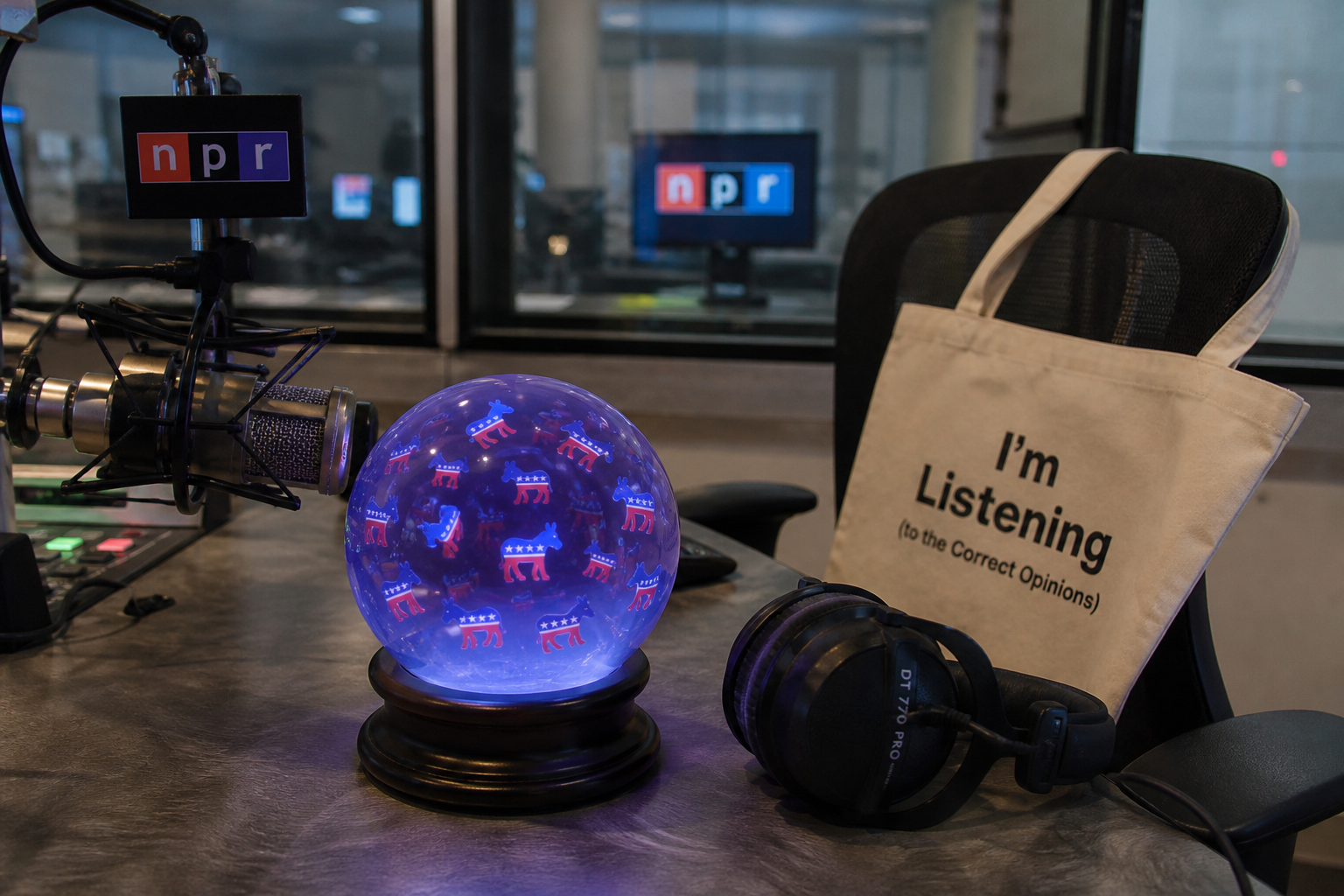
The shift in strategy was reportedly championed by NPR’s newly formed “Department of Narrative Foresight,” a committee tasked with aligning news coverage with the most desirable social and political outcomes. Their crystal ball, it seems, only glows blue.
An early draft of a script for an upcoming episode of All Things Considered demonstrates the new approach:
“Coming up next, we’ll explore the policy implications of Senator Johnson’s triumphant, though not-yet-official, reelection. We’ll speak with three experts who all agree that his pre-ordained victory is a watershed moment for the nation. But first, a look at how his challenger’s dangerous and divisive campaign has already been relegated to the dustbin of history.”
When asked how the network would handle a situation where the actual election results contradicted their pre-reported stories, the internal source was dismissive.
“That would be a clear case of voter error,” the source explained. “And we would have to cover that as the primary story: not that our reporting was wrong, but that the electorate failed to live up to our reporting. It would likely trigger a week-long series on the urgent need for electoral reform, featuring many concerned, soft-spoken academics.”
NPR has reportedly already prepared two sets of post-election articles. The first, to be published in the event of Democratic wins, is titled “A Nation Reaffirms Its Sanity.” The second, to be published in the event of Republican wins, is titled “An Autopsy of a Democracy.”


