

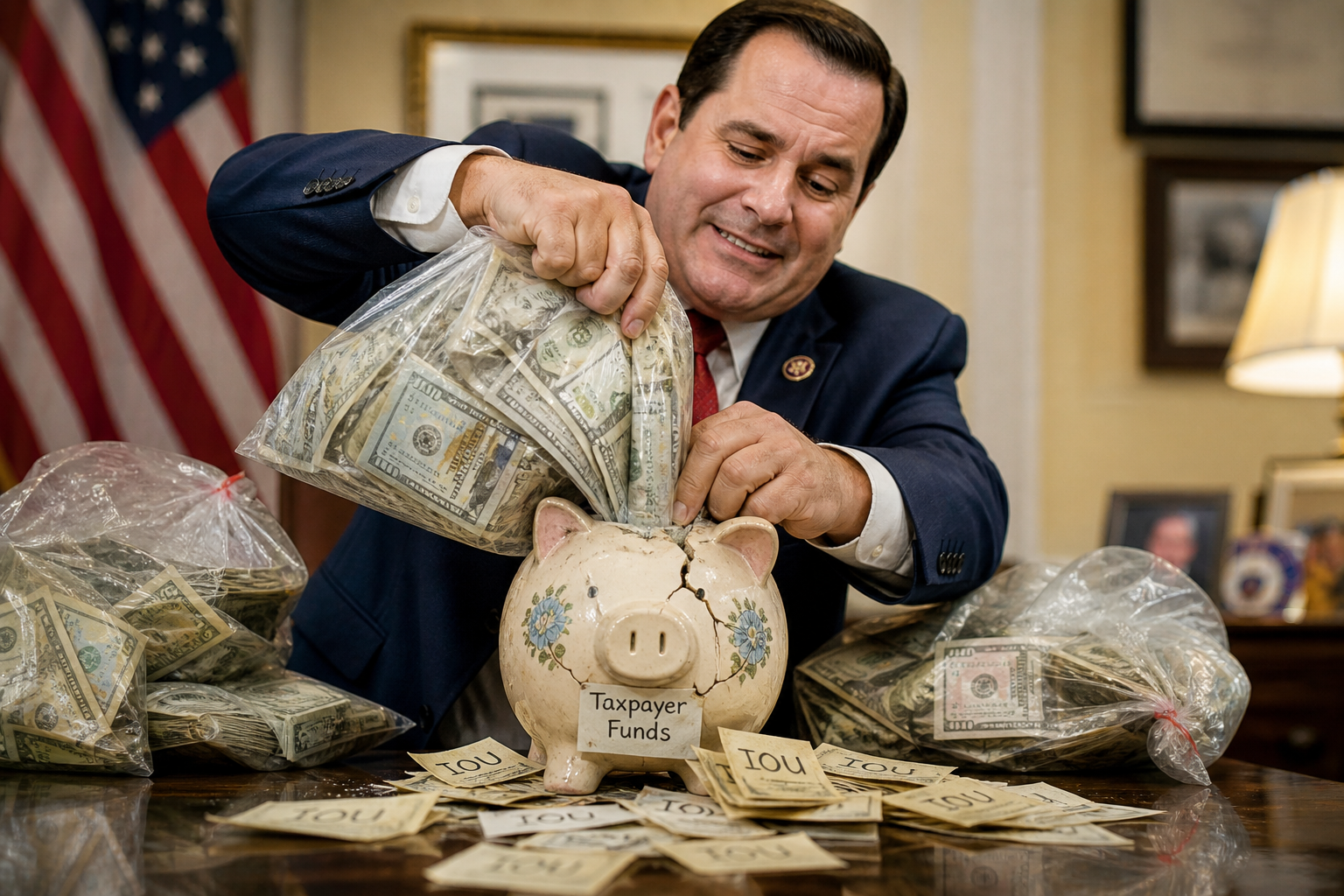
Washington Unveils Bold Plan To Fix Empty 'Lockbox' By Acquiring Keys To Someone Else's
WASHINGTON, D.C.—In a move celebrated for its sheer audacity, Democratic leaders this week unveiled a groundbreaking strategy to shore up Social Security, the federal retirement program they have expertly managed to the brink of insolvency over nine decades. The plan, officials explained, involves asking billionaires to finally “pay their fair share” into the meticulously maintained fund that has somehow evaporated under their party’s watchful eye.
“For almost a century, we have guarded the Social Security lockbox with unwavering vigilance,” explained Rep. Alexandria Ocasio-Cortez (D-NY) at a press conference, standing near a graph showing the fund’s trajectory heading sharply toward a large, unlabeled abyss. “It has been our sacred trust. Now, having successfully overseen this trust, we have concluded that its contents require a substantial infusion of cash from people who have been entirely too successful outside of our management.”
The proposal targets high-income earners, ensuring that those who have built vast fortunes will now have the distinct privilege of topping off a fund that generations of politicians have treated like a personal slush fund for everything from highway beautification projects to studies on the migratory patterns of the three-toed sloth.
A History of Unimpeachable Stewardship
Since its inception in 1935, Social Security has been described by its political guardians as the nation’s most sacred promise. Politicians from both parties, but primarily Democrats, have repeatedly assured the American people their money was safe, secure, and definitely not being 'borrowed' to pay for other, more immediate priorities with no concrete plan for repayment.
“Think of it less as ‘spending’ and more as an ‘internal strategic reallocation of assets’,” explained fictional progressive strategist Chad Peterson from the Center for Redefining Economic Realities. “The money was always there, spiritually. We just converted it into tangible assets, like votes and government programs. Now, to make it spiritually whole again, we need more actual money. It’s simple.”
Critics have often pointed out that the Social Security “trust fund” contains not cash, but non-marketable IOUs from the U.S. Treasury—essentially, a note from the government to itself promising to pay itself back one day. But proponents of the new plan dismiss this as a mere accounting technicality.
“Worrying about IOUs is very 20th-century thinking,” Peterson added. “We’re in a new era of economic justice. The important thing is not the structural integrity of the fund, but the moral purity of our intentions for it. And our intention is to have billionaires fill it back up.”
The 'Fair Share' Solution
The core of the new Democratic proposal rests on the principle of the “fair share,” a term whose definition dynamically adjusts to meet current budgetary shortfalls. In this case, “fair share” means the amount of money required to postpone the program’s collapse until after the next several election cycles.
“For too long, billionaires have been allowed to keep a disproportionate amount of the money they earned,” stated Senator Bernie Sanders (I-VT), a longtime advocate for expanding government programs by funding them with other people’s earnings. “We are simply correcting this market failure. It is only fair that their wealth be used to patch a nearly century-old hole that we, in our infinite wisdom, have been unable to patch ourselves.”
When asked why the program, after 90 years of collecting taxes from virtually every working American, was suddenly in need of a billionaire-funded rescue mission, officials explained that the situation was far more complex than simple mathematics.
“It’s not that the money was mismanaged,” one aide clarified on background. “It’s just that it was… managed. For 90 years. And things happen. Now, instead of dwelling on the past, we are looking forward to a future where the ultra-wealthy are mandated to participate in our ongoing fiscal experiment.”
The plan is reportedly part of a broader vision for the economy, where successful individuals are no longer viewed as creators of wealth, but as temporary custodians of future government revenue. Once passed, the new taxes are expected to solve Social Security’s funding crisis for at least a decade, at which point a new, even fairer share will likely need to be calculated for a new group of designated payers.


