

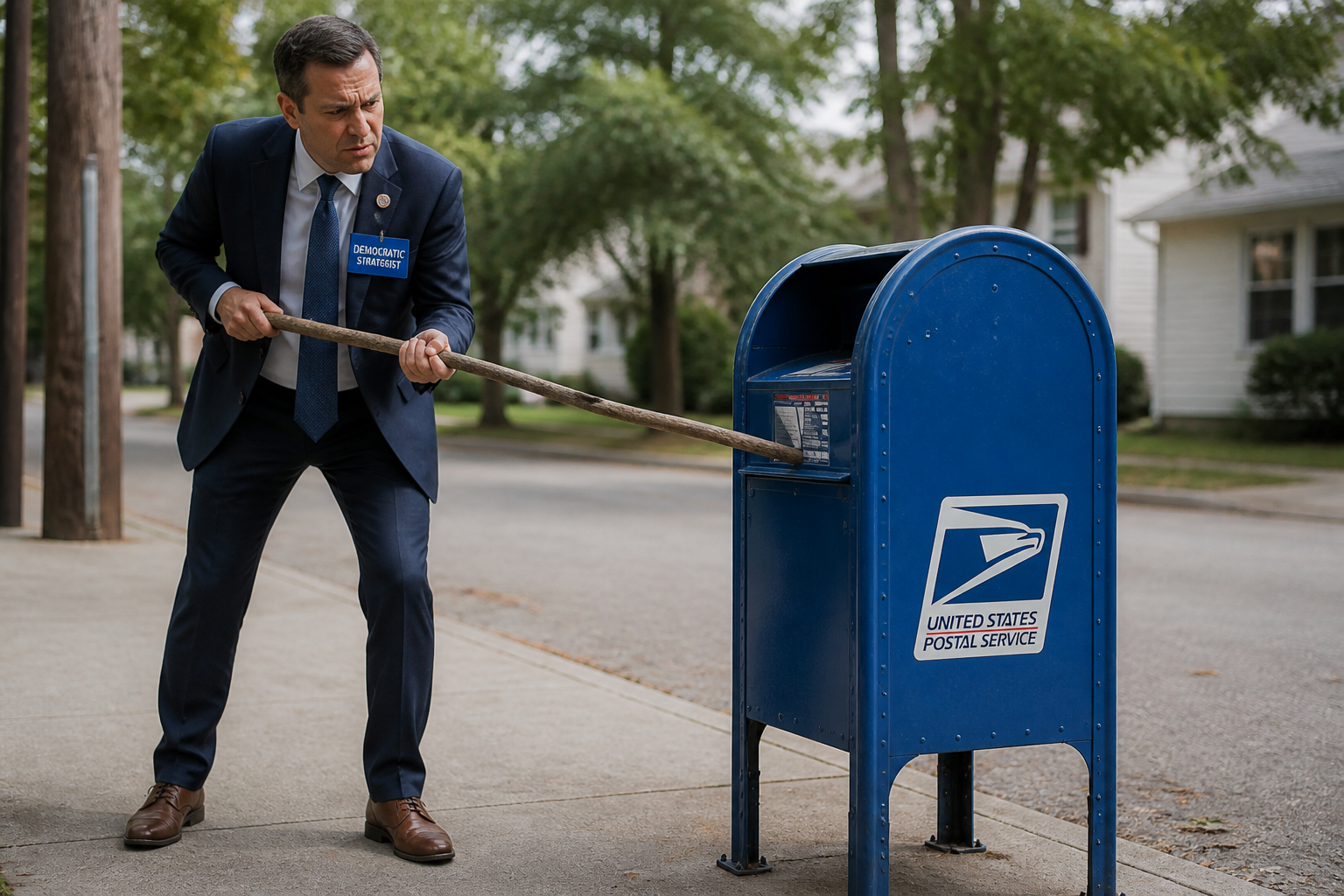
Progressives Bravely Discover Nuance Four Years After Declaring It Heresy
WASHINGTON, D.C.—In a stunning reversal that has left political archeologists breathless, the Democratic party has unearthed a fascinating and previously unknown concept: that the U.S. mail system, a government bureaucracy, might not be a flawless, divinely-inspired conduit for the sacred act of voting. The groundbreaking revelation, which apparently required a four-year, top-secret study, suggests that mail-in ballots could, in some hypothetical scenarios, get lost, be delayed, or have their signatures mismatched.
These concerns, long dismissed by leading academics and fact-checkers as a dangerous form of far-right folklore akin to believing in a flat earth, are now being cautiously whispered in the hallowed halls of progressive think tanks.
"We are beginning to process preliminary data suggesting that when you place a piece of paper into a complex network of sorting facilities and carriers, there is a non-zero chance it might not reach its destination in a timely or accurate fashion," stated Dr. Evelyn Reed of the newly formed Institute for Recently Acknowledged Realities. "This is a complex and nuanced issue that requires us to listen to the lived experiences of... well, of the exact same people we called conspiracy theorists in 2020."
The Great Un-Whistling
For years, the official position of the enlightened and compassionate was that any question regarding mail-in ballot security was, in fact, a racist dog whistle. The specific frequency of this whistle was so high that only individuals with a latent desire to suppress votes could perceive it. Ordinary, decent Americans heard only the smooth, reassuring hum of a functioning democracy.
"In 2020, we were clear: questioning the sanctity of the USPS drop box was tantamount to wearing a white hood to a polling place," explained progressive strategist Kyle Albright, who spent the last election cycle developing a proprietary algorithm to detect voter suppression in font choices on GOP mailers. "But it's 2024 now. Our understanding has evolved. We now see that questioning the sanctity of the USPS drop box is a vital part of protecting our democracy, especially when it helps us frame a potential loss as the result of a flawed system."
A leaked memo from the Democratic National Committee reportedly outlines the new approved terminology. Key takeaways include:
- When a Republican mentions signature verification, it is an act of "Systemic Disenfranchisement."
- When a Democrat mentions signature verification, it is a call for "Ensuring Every Voice is Heard Through Modernized Authentication Protocols."
- When a Republican discusses ballot harvesting, it is "A Nefarious Plot to Steal Elections."
- When a Democrat discusses ballot harvesting, it is referred to as "Community Vote Assistance and Mobilization."
- Concerns raised before November 2024 are "Baseless Attacks on Our Institutions." Concerns raised after November 2024 are "Urgent Audits Required to Safeguard Democracy."
Amnesia Afflicts Thousands
A wave of highly selective amnesia appears to be sweeping the nation's blue-check journalists and political commentators. Many have no recollection of writing articles or delivering impassioned monologues about how questioning mail-in voting was a direct assault on the republic.
"Did I write a 5,000-word piece titled 'Mail-In Skepticism: The Last Refuge of the Deplorable'?" asked one prominent cable news host, rubbing his temples. "That doesn't sound like me at all. I've always been a proponent of a robust, multi-faceted discussion on election logistics. Now, let's discuss the very real threat of ballots being rejected in key districts due to minor paperwork errors—a threat I have apparently been worried about my entire life."
Conservatives, who have spent four years being called paranoid election-deniers for raising these exact points, have graciously welcomed their political opponents to the conversation.
"We're just happy they've finally arrived," said one GOP official, setting out a plate of cookies and some informational pamphlets on how basic chain-of-custody works. "It's a bit like yelling 'fire' in a crowded theater for four years, being told you're a dangerous arsonist for doing so, and then having the people who called you an arsonist walk up and say, 'Pardon me, do you smell smoke?'"
As the nation heads toward another election, experts are watching to see what other formerly fringe ideas may become mainstream Democratic talking points. Early candidates include the theory that printing trillions of dollars could cause inflation and the wild notion that a border, by definition, is a line that separates two distinct areas.


