

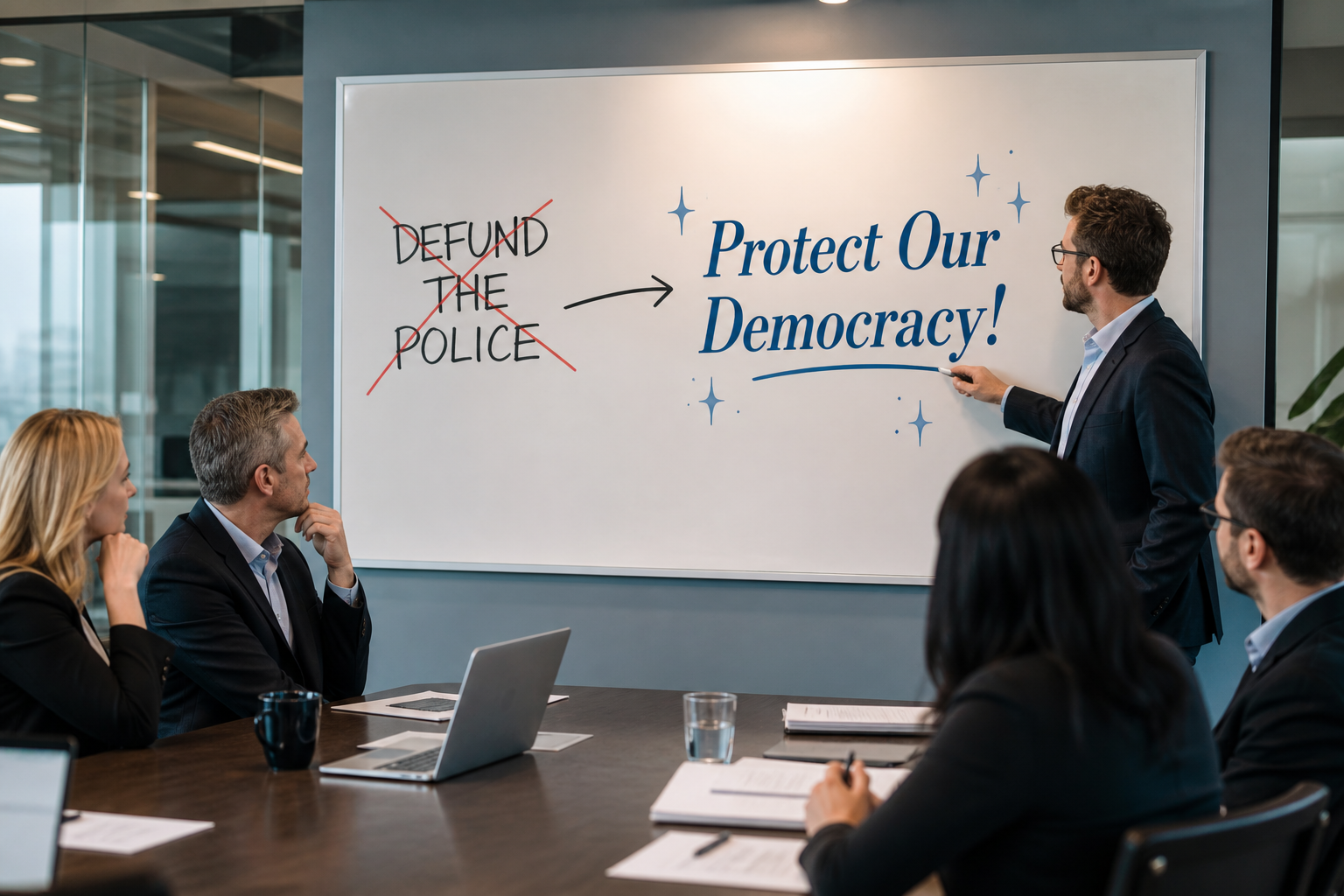
Marketing Department Unveils Its Masterpiece
WASHINGTON, D.C.—In a move celebrated by branding consultants everywhere, the Democratic National Committee’s marketing division has unveiled its flagship campaign for the upcoming election cycle: “Protecting Our Democracy.” The new slogan, which focus-grouped remarkably well with people who enjoy both freedom and breathing air, is being hailed as a masterstroke of political repositioning, designed to replace older, less popular slogans like “Defund the Police” and “Please Stop Asking Us About The Border.”
The new initiative reportedly came after internal polling revealed that phrases with negative connotations, such as “crippling inflation” and “skyrocketing urban crime,” were not resonating with key voter demographics. In contrast, “democracy” was found to have a 98% approval rating among people who believe they should have a say in their government.
“We realized we had a brand equity problem,” explained Chad Pembrooke, a senior strategist who left a lucrative career rebranding failed soft drinks to join the cause. “Our core products were sound, but the packaging was all wrong. You can’t sell ‘Community-Led Violence Interruption’ when voters are mostly concerned about actual interruption of violence. But ‘Protecting Our Democracy’? That’s a premium brand. It’s the organic, fair-trade, artisanal kombucha of political slogans.”
The Old Product in a Shiny New Wrapper
The “Protecting Our Democracy” platform serves as a convenient and spacious umbrella for a variety of preexisting policy goals that had previously struggled in the marketplace of ideas. An internal memo, allegedly leaked from a whiteboard during a brainstorming session, outlines the strategy:
- Defund the Police has been seamlessly rebranded as “Reimagining Public Safety to Uphold Democratic Norms.” This new approach ensures that when your car is stolen, you can rest easy knowing the process was at least democratically equitable.
- Federal Election Takeovers are now being marketed under the much friendlier banner of “Securing Voting Access to Safeguard Democracy.” This ensures that democracy is so safe, it’s managed exclusively by the experts in Washington.
- Packing the Supreme Court, a term deemed “a little aggressive” in focus groups, has been softened to “Judicial Rebalancing for a More Resilient Democracy.” Proponents argue that the best way to protect the integrity of an institution is to add more people to it until you get the answers you want.
- Sweeping Green Energy Mandates have been repackaged as “Combating Climate Change to Protect the Future of Our Democratic Planet,” cleverly linking your gas stove to the downfall of Western civilization.
Voters Respond with Cautious Confusion
The rollout has been met with a mixture of enthusiasm and mild bewilderment from the public. Local voter Brenda Matthews, 48, expressed her thoughts while filling her gas tank.
“I heard on the news that the biggest threat we face is to our democracy,” she said, looking at the pump ticking past $80. “I thought the biggest threat was my grocery bill, but I’m glad the experts have clarified things. I assume protecting democracy will somehow make these numbers go down?”
Political analysts have noted the genius of the strategy. By framing every issue as an existential threat to democracy itself, any opposition can be neatly categorized as anti-democratic.
“It’s bulletproof,” Pembrooke added, adjusting his fleece vest. “You don’t agree with our economic plan? Why do you hate democracy? You think maybe we should enforce immigration laws? Classic anti-democracy talking point. It streamlines the debate and saves everyone a lot of time.”
As the election cycle heats up, voters can expect to hear the phrase “Protecting Our Democracy” used to justify everything from zoning regulations to school lunch menus. The DNC is reportedly already workshopping its next slogan for 2026, with “The Freedom Framework” and “Civic Wellness Initiative” leading the pack, ensuring that no matter what the problem is, the solution will always have a fantastic name.


