

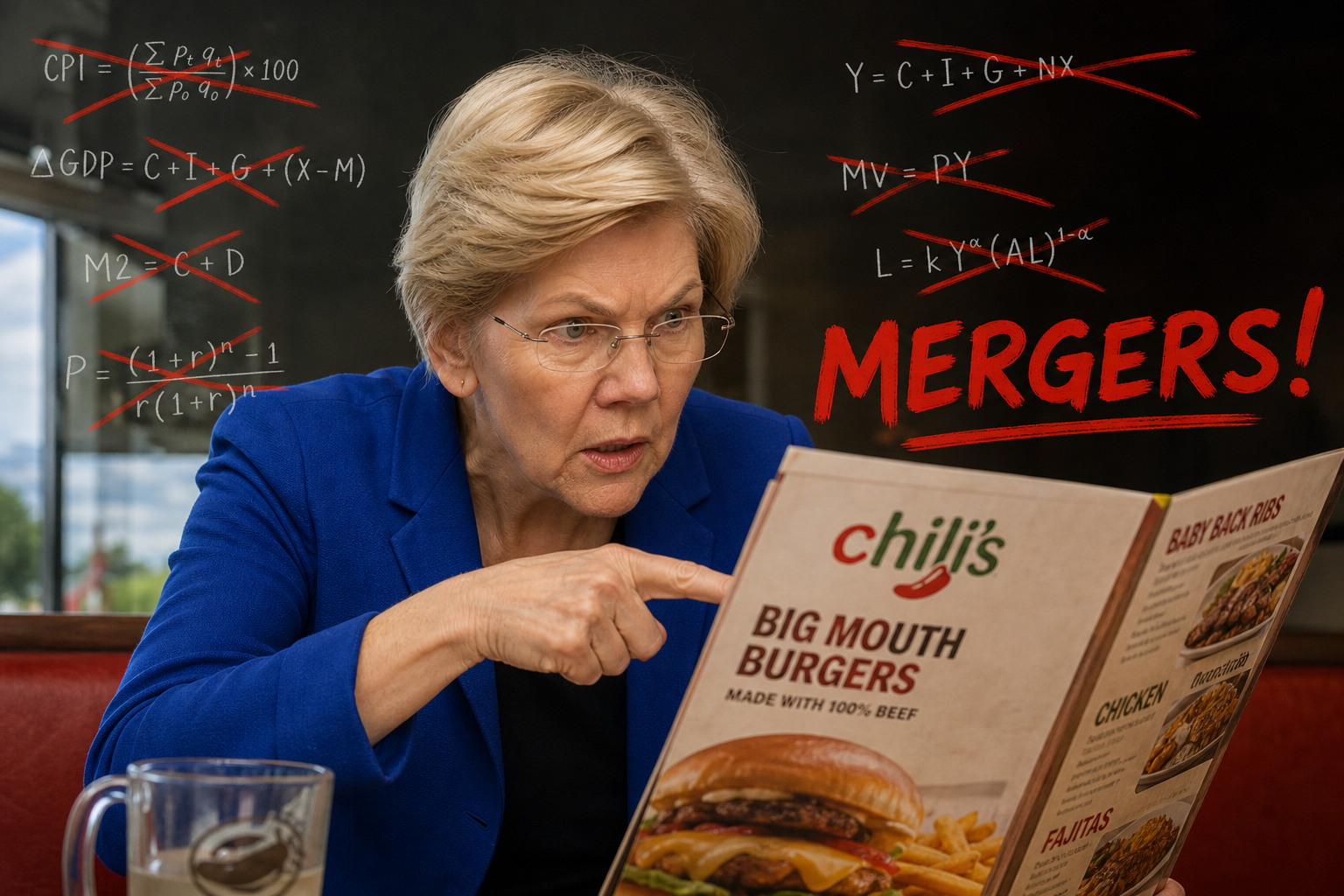
Nation's Leading Financial Detective Cracks Case Of The $18 Appetizer
WASHINGTON, D.C.—In a breakthrough that has sent ripples through both the culinary and economic worlds, Senator Elizabeth Warren announced this week she has single-handedly solved the mystery of why your dinner bill looks like a down payment on a used car. After what sources describe as a grueling, minutes-long investigation, the senator concluded that rising prices at chains like Olive Garden and Red Lobster are not due to rampant inflation, skyrocketing labor costs, or supply chain chaos, but are instead the work of a shadowy cabal of greedy executives merging in boardrooms.
“Americans are paying more for their Cheddar Bay Biscuits, and I’ve discovered why,” Warren declared in a recent social media post, bravely speaking truth to the power of casual dining conglomerates. “Private equity firms and corporate mergers are gobbling up restaurant chains and squeezing families. This has nothing to do with printing trillions of dollars or forcing businesses in blue states to pay a starting wage that’s higher than the per capita GDP of 47 countries. It’s just greed.”
A Theory So Simple, It Ignores Everything Else
The Senator’s Unified Field Theory of Restaurant Pricing posits that when two mid-tier steakhouse chains merge, a dark energy is released that automatically adds $3 to the price of a sirloin. When a private equity firm buys a seafood restaurant, as was the case with Red Lobster, the firm’s inherent greed particles infect the menu, causing the price of the Ultimate Feast to inflate faster than the national debt.
“It’s just science,” explained a fictional intern in the Senator’s office. “We looked at all the complicated charts about money supply and labor force participation, and they were very confusing. Then we saw a headline about a merger, and it all clicked. It’s so much easier to blame a few guys in suits than it is to analyze the direct consequences of your own legislative priorities.”
This bold theory conveniently sidesteps any mention of recent policy decisions that have impacted the service industry. For instance, California’s new $20-per-hour minimum wage for fast-food workers—a policy widely celebrated by progressives—has been completely ruled out as a potential factor in why a Big Mac combo now requires a credit check. According to the Warren Doctrine, that price hike was caused by lingering corporate avarice from the Burger King-Tim Hortons merger of 2014.
The Common Man, Confused
Local restaurant owner Dave Martin, who runs a single, non-merged diner, was perplexed by the Senator’s findings.
“So when my egg supplier charges me 40% more, and my new line cook is making what my manager used to make, and my energy bill has doubled... that’s all because LongHorn Steakhouse and Capital Grille have the same parent company?” he asked, wiping down a counter. “I thought I was raising prices to, you know, avoid going bankrupt. It’s a relief to know I’m just an unwitting pawn in a game of corporate monopoly.”
Meanwhile, economists who have gently tried to introduce concepts like “inflation” into the conversation have been dismissed as corporate shills. “Look, when the government injects trillions of new dollars into the economy, and the cost of labor and goods goes up for everyone, prices rise everywhere,” one economist tried to explain before being drowned out by chants of “Break them up!”
Senator Warren has vowed to continue her fight, promising to hold hearings and form a subcommittee to investigate the monopolistic tendencies of the Bloomin' Onion. Her proposed solution includes a federal task force to ensure adequate spacing between all Olive Gardens and a mandate that all corporate executives spend one weekend a month working a deep fryer to learn humility.
“We will not rest,” she proclaimed, “until every American can once again enjoy a basket of endless breadsticks without having to worry that a private equity ghoul is getting a cut.” The price of flour, yeast, and the gas needed to transport them remain under investigation, pending confirmation they have not recently merged.


