

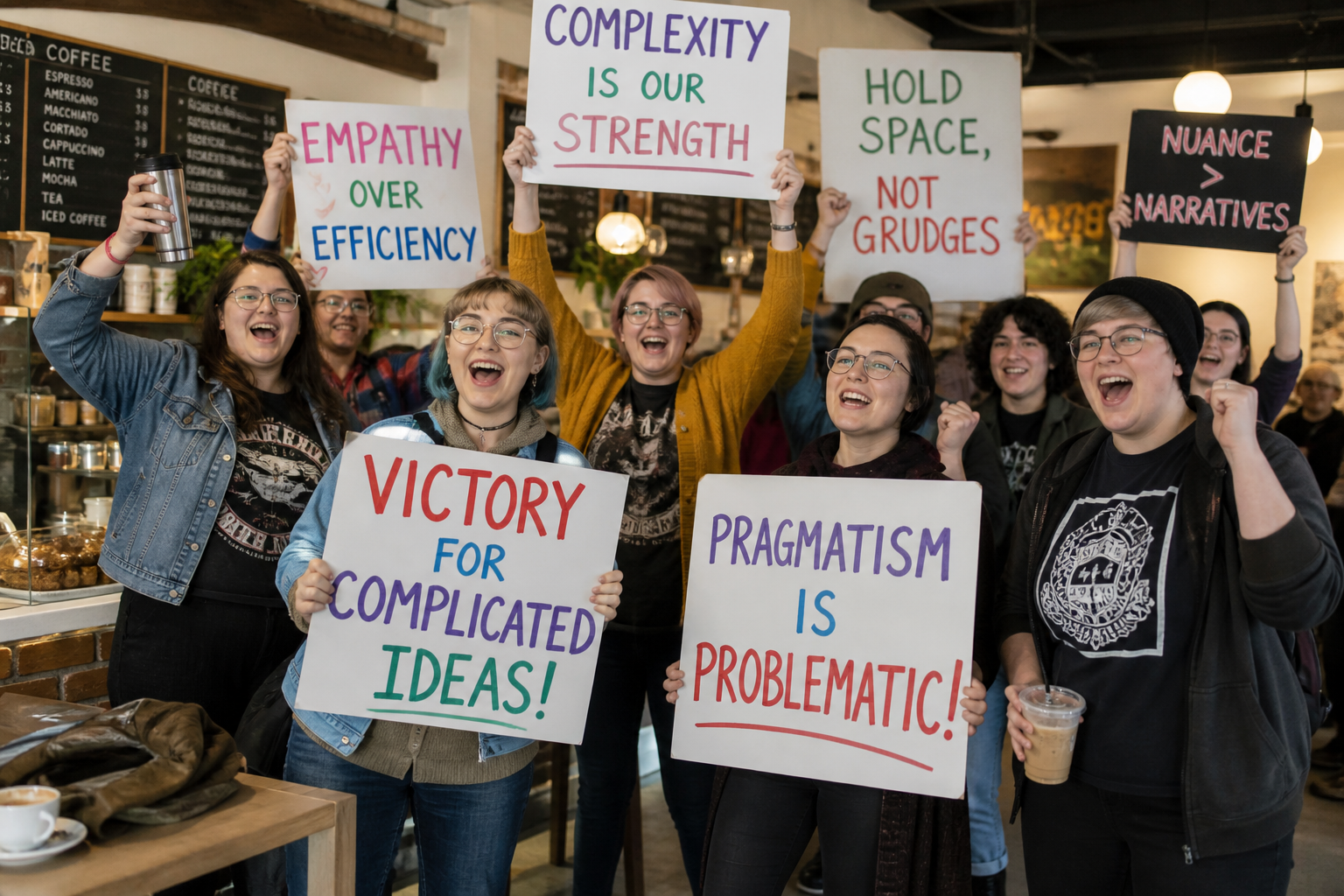
Party Rejects 'Electability' As A Concept Invented By People Who Own Lawn Mowers
MINNEAPOLIS, MN – In a move celebrated by dozens of activists in the immediate vicinity of a fair-trade coffee shop, Democratic-Farmer-Labor Party voters in Minnesota’s 5th Congressional District narrowly re-nominated Rep. Ilhan Omar, decisively settling the question of whether the party should try to win elections or just win arguments on social media.
The hard-fought primary victory over a more moderate challenger, who tragically campaigned on boring issues like crime and constituent services, was hailed as a triumph for the progressive movement. Supporters lauded the outcome as proof that voters, when given a choice, will always pick the candidate whose policy positions are best explained in a 400-level university course syllabus.
“This is a clear mandate,” declared local activist Juniper Sage, speaking to reporters from a folding chair at a victory party held in a community art space. “A mandate to continue pursuing a bold, transformative agenda that polls exceptionally well among people who list their pronouns in their email signatures. The rest of the country just needs to read more Foucault and catch up.”
The campaign reportedly centered on the radical idea that electability—the antiquated notion that a candidate should be able to appeal to voters outside of their own zip code—was a tool of the political establishment. By rejecting challenger Don Samuels, who was endorsed by the local paper and the city’s mayor, voters sent a powerful message that they would rather lose with a pure heart than win with a candidate who might have once shaken hands with a landlord.
“We were getting dangerously close to nominating someone who could have a normal conversation at a VFW hall,” worried one campaign volunteer, who asked to be identified only by their preferred descriptor, ‘a being of light and struggle.’ “Thank goodness we dodged that bullet. Winning over moderates is a slippery slope to compromising our values, like the core value of making sure no one in rural Wisconsin understands what we’re talking about.”
A Strategy for the Future
Political analysts nationwide immediately took note of the DFL’s bold strategy. “It’s a fascinating approach,” said one fictional political consultant reached for comment. “The prevailing wisdom has been to find common ground and build broad coalitions. The 5th District’s voters have pioneered a new path: find the most niche, academically-dense ideological position and then berate everyone who doesn’t immediately agree.”
While Rep. Omar won by a comfortable, if not overwhelming, margin in her deep-blue district, her supporters are confident that her platform can be easily scaled up to win statewide races in places like Montana and West Virginia.
“People in Appalachia are clamoring for a conversation about decolonizing their public spaces, they just don’t know it yet,” explained a campaign strategist. “Our data, gathered entirely from surveys of our own interns, shows that what Midwestern swing voters really want is a candidate who uses the word ‘problematic’ at least twelve times in every speech.”
The narrowness of the victory was dismissed by the campaign as irrelevant. “Securing 50.3% of the vote in a primary is basically a unanimous endorsement from the people,” Sage clarified. “It proves that nearly a narrow majority of Democrats in one of the most liberal districts in America are fully on board. From here, convincing everyone else should be simple. It just requires them to fundamentally change all their beliefs, priorities, and lived experiences.”
As the celebration wound down, DFL party leaders expressed optimism about the future. They remain confident that their strategy of nominating candidates who are heroes on Twitter but politically toxic outside of a three-block radius of a university campus is a long-term winner.
“Any day now, the rest of the country is going to see the light,” one official was heard muttering while carefully composting his paper plate. “And if they don’t, it’s clearly their own fault for not being educated enough.”


